Power banks on planes: rules on 6 US airlines (2026)
Yes, you can fly with a power bank, but only in your carry-on and up to 100 Wh without approval. Southwest now allows one per person, most others two, and several ban them from overhead bins and seat charging. Here are the rules airline by airline.
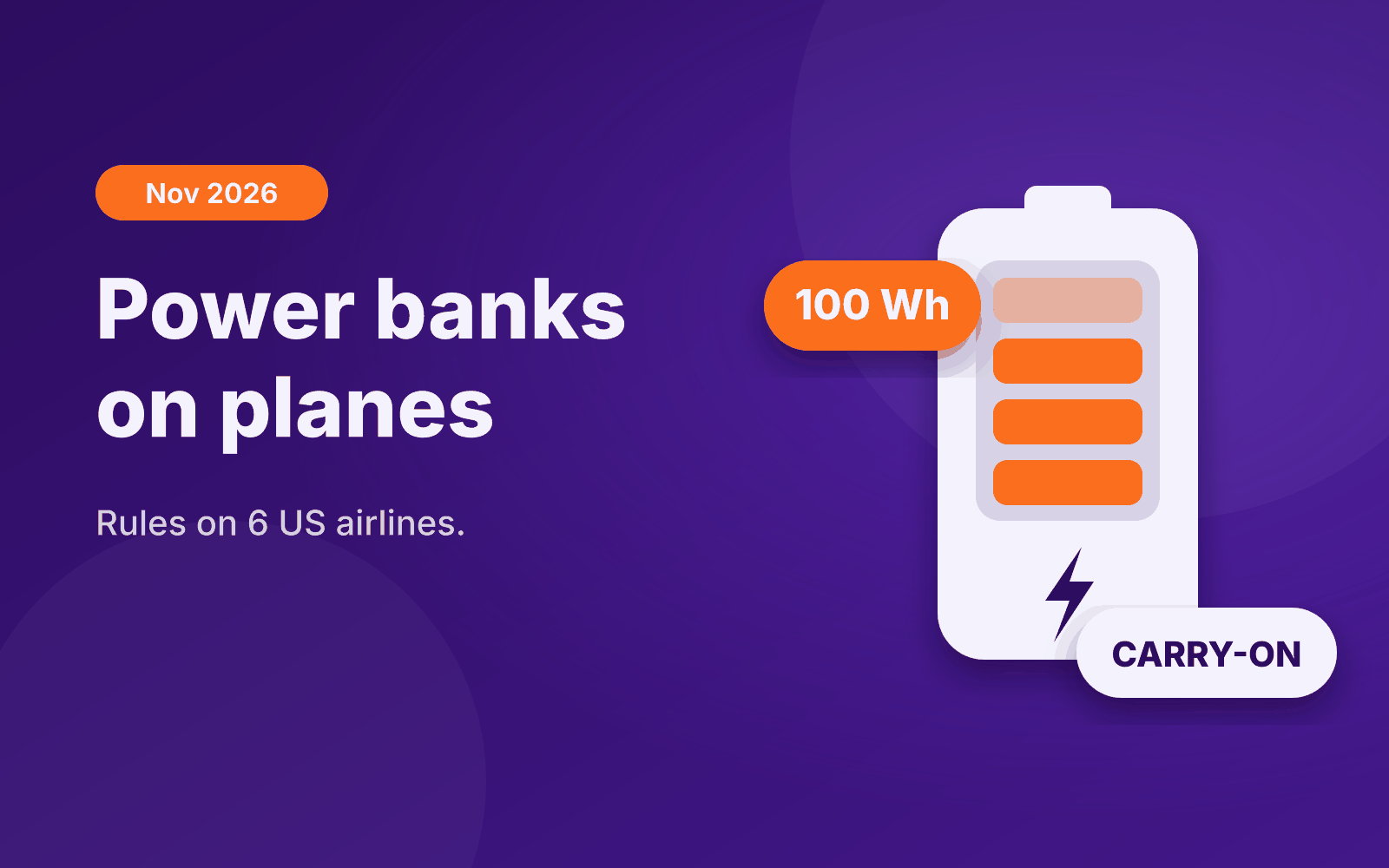
Yes, you can bring a power bank on a plane, but only in your carry-on, and only up to 100 watt-hours without the airline's approval. What changed in 2026 is what you can do with it once you're on board. Southwest now allows one per person, most other big US airlines allow two, and several ban them from the overhead bin and from in-seat charging.
The airline operating your flight sets the rules on top of the FAA's, so check the table below for your carrier before you pack.
The FAA baseline on every US flight
These rules apply whichever airline you fly:
- Power banks and spare lithium batteries go in your carry-on only, never in checked bags.
- If your carry-on gets checked at the gate, take the power bank out and keep it with you in the cabin.
- Each one can be up to 100 watt-hours (Wh) with no approval needed.
- With the airline's approval, you can carry up to two larger spares between 101 and 160 Wh.
- The terminals need protecting from short circuits. A retail box, a strip of tape or a small pouch does it.
The FAA also says airlines may set stricter limits on how many you carry and how big they are. Southwest, United and American all tightened theirs in 2026.
Power bank rules by US airline
| Airline | Power banks per person | Size limit | Overhead bin | Charging on board |
|---|---|---|---|---|
| Southwest | 1 (since April 20, 2026) | 100 Wh | Not allowed; keep it in a personal item under the seat | Can't be charged from in-seat power; must be visible when in use |
| American | 2 | 100 Wh each | Not allowed | Can't be recharged from seat outlets; keep it visible when in use |
| Delta | 2 | 100 Wh each, no exceptions | Not allowed | Must not be recharged on board, or used to charge a device during taxi, takeoff and landing |
| JetBlue | 2 | 100 Wh | Not allowed | Can't be charged from in-seat power; shouldn't be used to charge other devices in flight |
| United | Up to 2 lithium batteries in carry-on | 160 Wh maximum | Keep it on you or in a personal item (since March 1, 2026, as reported) | United's page doesn't say |
| Alaska | FAA limits; no more than 2 spares above 100 Wh | 100 Wh, or up to 160 Wh for larger spares | Alaska's page doesn't say | Alaska's page doesn't say |
From each airline's own baggage or restricted-items page, checked 28 November 2026. United's overhead-bin rule comes from Travel Market Report, because United's policy page doesn't load as plain text.
Southwest is the one to watch on a family trip. The limit is one power bank per customer, so a parent can't carry extras for everyone else. Each traveler's allowance is their own.
International flights since March 2026
The International Civil Aviation Organization (ICAO), the UN body that sets global air safety standards, added new power bank rules that apply from 27 March 2026. Passengers can carry no more than two power banks, they must not be recharged on board, and they shouldn't be used to recharge a phone or other device during the flight.
Some foreign airlines and countries go further. Delta warns that breaking the portable charger rules on trips to South Korea could bring significant financial penalties. On a connection to an international flight, plan for the strictest airline on your ticket.
Checking your power bank's watt-hours
Most power banks print the rating on the back or the base. If yours only lists milliamp-hours (mAh), American Airlines gives the formula: Wh = mAh × 3.7 ÷ 1,000.
That puts a 10,000 mAh charger at 37 Wh and a 20,000 mAh charger at 74 Wh, both well inside the 100 Wh limit. At 27,000 mAh you're at about 100 Wh, so a bigger bank needs the airline's approval or should stay home.
Large portable power stations are a different category. American doesn't accept them as carry-on or checked items, and its page names EcoFlow, Jackery and Bluetti among the brands it won't take.
Keeping it under the seat during the flight
Put the power bank in your personal item under the seat in front of you, or in the seatback pocket. On Southwest, American, Delta and JetBlue that isn't a suggestion: their rules keep power banks out of the overhead bin, so crew can reach one quickly if it overheats.
Gate-checks catch people out. If the overhead bins fill up and your roller bag is tagged at the door, the power bank has to come out before the bag goes below. Small regional jets are a common case. Our guide to carry-on bag size limits by US airline covers which flights gate-check larger bags, and why chargers belong in your personal item.
Power banks as holiday gifts
If a power bank is on your gift list, it still goes in your carry-on, wrapped or not. Never pack one in a checked bag of presents. If you're flying Southwest, remember the one-per-person limit before you buy a two-pack for the trip.
For the rest of the security line, our guide to flying without REAL ID covers the ID rules and the $45 TSA ConfirmID fee.
Booking through EazAir
EazAir compares fares from partner booking sites and hands you to the partner you choose to book. The battery rules belong to the airline that operates your flight, so check its name on the itinerary, especially on a connection. When you're ready to compare fares, start with EazAir flights.
Sources
- FAA, PackSafe: Lithium Batteries, checked 28 Nov 2026
- ICAO, Addendum No. 1 to the 2025-2026 Technical Instructions (Doc 9284), checked 28 Nov 2026
- Southwest Airlines, Traveling with lithium batteries, portable chargers/power banks, e-cigarettes, and lighters, checked 28 Nov 2026
- American Airlines, Restricted items, checked 28 Nov 2026
- Delta Air Lines, Battery or Fuel-Powered Items, checked 28 Nov 2026
- JetBlue, Batteries, checked 28 Nov 2026
- United Airlines, Dangerous items, checked 28 Nov 2026
- Alaska Airlines, Spare batteries and electronic devices, checked 28 Nov 2026
- Travel Market Report, American Airlines tightens power bank rules following FAA safety warning, checked 28 Nov 2026